
01-10-2026
A campervan or caravan on your doorstep: what’s allowed and what isn’t?
Motorhome or caravan on the doorstep: what’s allowed and what isn’t?
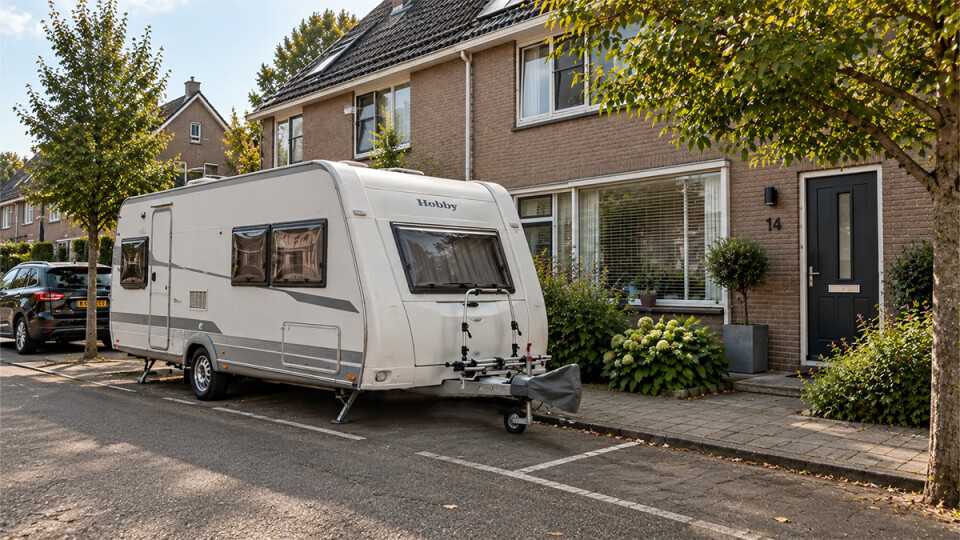
Parking the motorhome on the doorstep in advance so you can pack it for your holiday. Or leaving the caravan there for a few days after you get home so you can unpack everything at your leisure. It’s practical, but is it actually allowed?
This varies from one local authority to another. Local authorities set out rules for the parking of motorhomes, caravans and other recreational vehicles in their General Local Regulations (APV) and, in some cases, in supplementary by-laws.
Why are there separate rules for motorhomes and caravans?
A motorhome or caravan takes up a relatively large amount of space and is not usually used as a means of transport on a daily basis. When such a vehicle is left on the street for a prolonged period, this can reduce the available parking space or cause a nuisance. That is why many local authorities distinguish between normal parking and the long-term parking of a recreational vehicle. Spending a few days before departure packing up the caravan is often not a problem. Leaving the caravan in the same spot for weeks on end, however, may well be a problem.
The well-known three-day rule
The time limit you often come across is three consecutive days. This does not automatically mean that this rule works exactly the same way in every Dutch local authority. The precise wording and any exceptions are determined locally.
For example, in Dordrecht, within the built-up area, a vehicle used for recreational or non-traffic purposes may not be parked or kept on the road for more than three consecutive days. The local authority may, however, grant an exemption for this.
In Gorinchem, too, a limit of a maximum of three consecutive days applies within built-up areas. In addition, the local authority has a separate designation order regarding the parking of recreational vehicles. This designates areas where it is prohibited to park motorhomes, caravans and trailers, amongst other things, for longer than three days. In certain designated locations, an even stricter ban may apply.
On Goeree-Overflakkee, which also includes Oude-Tonge, the rule within built-up areas is likewise that a recreational vehicle may not be left on the road for more than three consecutive days. The local authority explicitly states on its own website that a caravan or motorhome may be parked in a public space for a maximum of three days. In exceptional cases, an exemption may be applied for.
Move it for a bit and then park it for another three days?
Moving your caravan a few parking spaces further on after three days is not necessarily a solution. The aim of these kinds of rules is precisely to prevent the long-term use of public parking spaces by recreational vehicles. Municipalities may therefore consider the actual situation and not just the exact parking bay. Explanatory notes accompanying these kinds of General Public Order Regulations explicitly state that moving a caravan or trailer a few metres is not intended to start a new period.
And what about a motorhome or caravan on your own property?
A private driveway or yard is a different situation to a public road. The well-known three-day rule relates to stopping or parking on the road and therefore cannot simply be applied one-to-one to your own property. However, that does not automatically mean that everything is permitted on your own property. Depending on the local authority, location and situation, factors such as the local development plan, local by-laws or regulations governing the use of a plot of land may be relevant. You should therefore always check the rules that apply to your address when parking on your own property, particularly if a motorhome or caravan is to remain outside for an extended period.
How to find the rules for your local authority
Do you want to know exactly what is permitted in your area? Then search the website of your local authority or the local regulations on Overheid.nl. Use search terms such as ‘APV camper’, ‘APV caravan’, ‘camping equipment’, ‘recreational vehicles’, ‘caravan parking’ or ‘parking of large vehicles’. Don’t just focus on the APV itself. Some local authorities also issue separate designation orders specifying the roads or locations where additional parking rules apply. You should also always check that you are referring to the current, valid version of the regulations, as local authority rules are subject to change.
What happens if your campervan or caravan is left parked for too long?
Local authorities can monitor compliance with the APV. For example, following a report or during a routine inspection, a special investigating officer (BOA) may find that a motorhome or caravan has been parked at the same location for an extended period. What happens next depends on the local authority and the situation. For instance, the owner may be contacted, or enforcement action may be taken. You should therefore not assume that you can leave your caravan or motorhome parked on the street for an extended period without consequences.
Especially as autumn approaches, a motorhome or caravan is often left stationary for a longer period. In such cases, the public car park outside your front door is not intended as a permanent storage space.
A permanent storage facility offers a solution. Your motorhome or caravan won’t be left on the street for weeks or months, and you’ll have a fixed place where you can store the vehicle. With indoor storage, the vehicle is also protected from the elements. Proper preparation for a longer storage period remains important: remember to drain pipes and tanks, ventilate the vehicle, check tyre pressure and take care of the battery.
At Multibox, there are various options for storing motorhomes and caravans. This means that after your last trip, you can unpack at your leisure and then store your vehicle in a designated space.
Tip: before parking your motorhome or caravan for an extended period, always check the current regulations in your local council area. This way, you’ll not only keep your vehicle in good condition but also maintain a good relationship with your neighbours.
Would you like to know what spaces are still available in the car park at Kerkeplaat in Dordrecht? Please get in touch with us.
We are happy to help!
MULTIBOX
Contact us
Headquarters
Kerkeplaat 2R, 3313LC Dordrecht